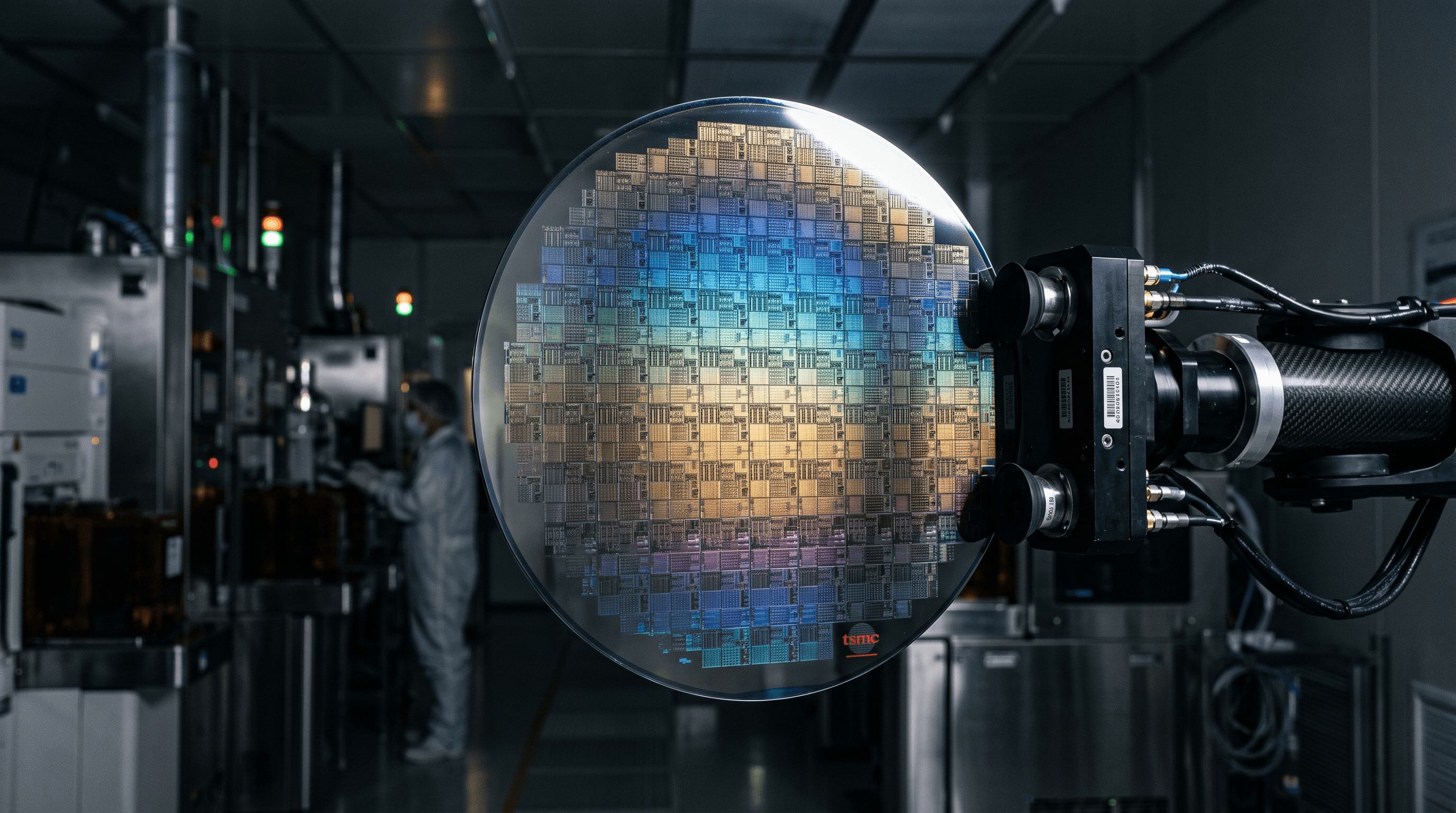
Most analysts focus on Nvidia's latest AI chip speeds, but the real story is how it reshapes the economics of data centers. With efficiency gains that dwarf competitors, NVDA is forcing a rethink of semiconductor valuations.
The Efficiency Edge
NVDA's Blackwell GPU achieves roughly 2.5x the performance per watt of AMD's MI300X, based on recent benchmarks. For a hyperscaler running 100,000 GPUs, this translates to annual power savings around $1 billion. The efficiency gains aren't incremental — they're transformational.
| Ticker |
Latest Chip |
Performance/Watt |
Price |
Power Savings/Unit |
| NVDA |
Blackwell |
~2.5x MI300X |
~$40K |
~$10K/year |
| AMD |
MI300X |
Baseline |
~$35K |
Baseline |
| INTC |
Gaudi3 |
~0.8x MI300X |
~$30K |
~-$2K/year |
| GOOGL |
TPU v5 |
~1.2x MI300X |
N/A |
~$3K/year |
| MSFT |
Maia |
~1.1x MI300X |
N/A |
~$2K/year |
The Competitive Landscape
While NVDA leads in raw performance, competitors are taking different approaches. GOOGL and MSFT are investing heavily in custom AI chips optimized for their cloud platforms. INTC is betting on lower prices to gain market share, though its efficiency lags.
The risk for Nvidia is pricing itself out of the market. At $40,000 per unit, Blackwell adoption may be limited to hyperscalers and major AI labs. Smaller enterprises could opt for cheaper alternatives despite lower efficiency.
The Historical Parallel
This mirrors NVDA's 2018 dominance in gaming GPUs, where its Turing architecture achieved similar efficiency gains over AMD. Back then, the RTX 2080 Ti commanded a 50% price premium but captured 80% of the high-end market. The question is whether AI buyers will follow the same pattern.
Ready to analyze these stocks? Search any ticker on MainRatios to see valuations from 6 legendary investors — free.