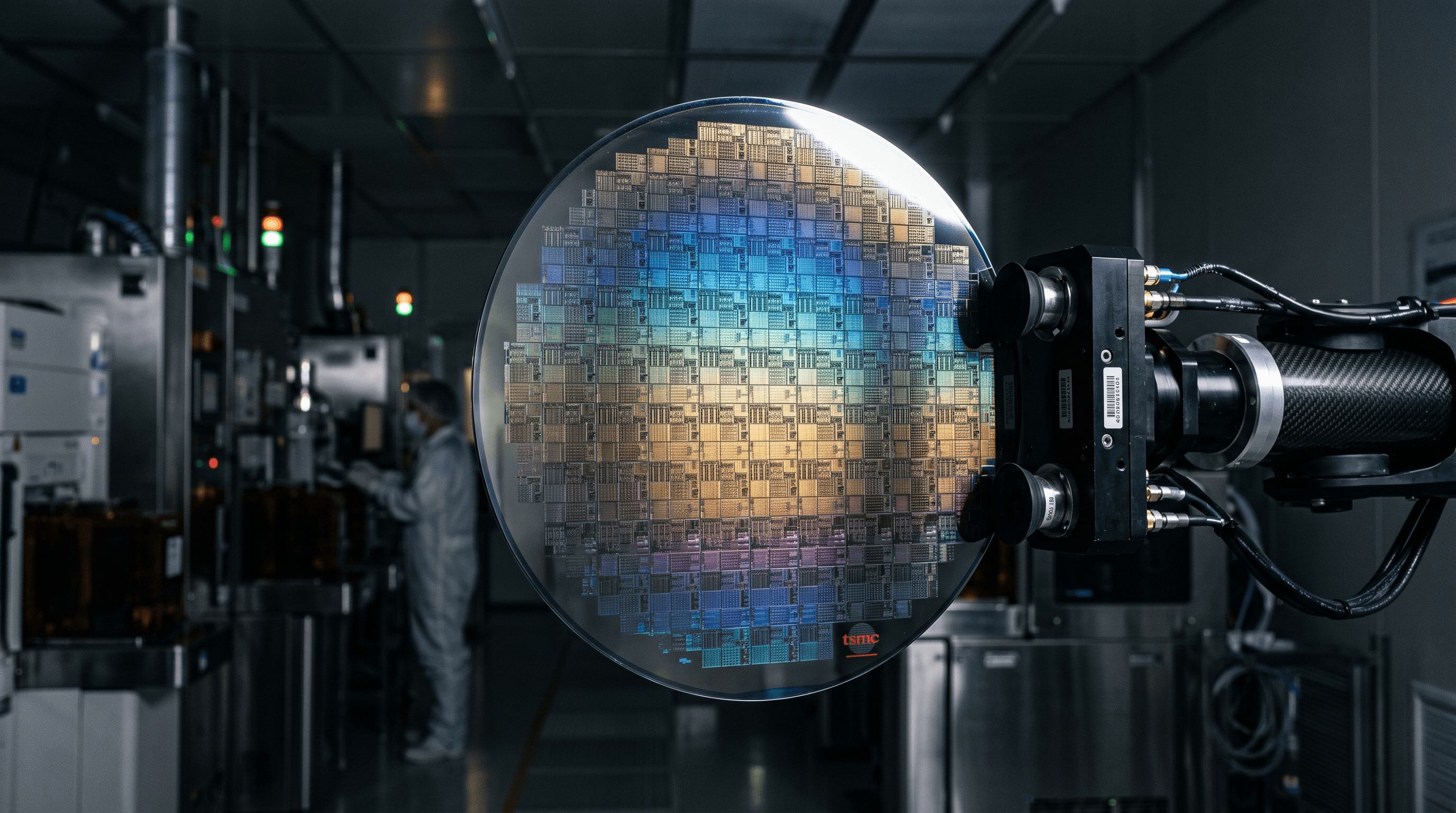
Four of the Magnificent 7 just committed $650 billion in combined 2026 capex. That is a 71% year-over-year jump. It is more than the entire annual defense budgets of France, Germany, and the UK combined — and every dollar of it has to land somewhere inside the semiconductor supply chain.
Wall Street raised its 2026 hyperscaler spending estimate from $465 billion to $527 billion in a single earnings season, then blew through that number within weeks. World Semiconductor Trade Statistics now projects roughly 26% industry revenue growth to about $975 billion, while Bank of America analyst Vivek Arya is modeling closer to 30% — which would cross the $1 trillion threshold for the first time in history.
Underneath the headlines, however, something more interesting is happening. The biggest 2026 winners are not who you think they are.
What Wall Street Just Recalibrated
At the start of Q3 2025 earnings season, the consensus estimate for 2026 hyperscaler capex was around $465 billion. By the end of the earnings calls, that number had climbed closer to $527 billion. A few weeks later it was pushing $650 billion. The pace of upward revision is among the fastest in the history of the semiconductor cycle.
Microsoft (MSFT), Alphabet (GOOGL), Amazon (AMZN), and Meta Platforms (META) account for roughly 80% of the incremental dollar flow. What makes 2026 different from 2024 or 2025 is not just the magnitude — it is the composition. The marginal dollar is shifting away from pure merchant GPUs and toward custom silicon, high-bandwidth memory, and advanced packaging capacity.
That composition shift matters because it rewires who captures the margin.
The Picks-and-Shovels Winners
The obvious trade is Nvidia (NVDA), which still captures the lion's share of AI accelerator revenue. But the more interesting exposure heading into the back half of 2026 sits one tier upstream — the companies that make the tools NVDA and its peers need to manufacture advanced chips.
Here is what the 2026 supply chain looks like today:
| Segment |
Representative Stock |
2026 Growth Driver |
| AI Accelerators |
NVDA |
Blackwell Ultra ramp, sovereign AI deals |
| Custom AI Silicon |
AVGO |
Google TPU, Meta MTIA, hyperscaler ASICs |
| High-Bandwidth Memory |
MU |
HBM3E capacity sold out through 2026 |
| Wafer-Fab Equipment |
AMAT |
Advanced-packaging capex |
| Process Control |
KLAC |
Yield ramp on 2nm logic |
| CPUs and Accelerators |
AMD |
MI400 ramp, server share gains |
Memory is the sleeper trade. HBM3E capacity is effectively sold out through 2026, and pricing power has returned to the memory oligopoly for the first time since the 2018 cycle peak. MU's contract pricing is increasingly locked in well in advance, which is unusual for a historically commodity producer. Critics will argue that memory cycles eventually break, and they are right — but the break rarely arrives during the capacity-tight phase.
The Power Bottleneck Nobody Wants to Talk About
Deloitte estimates that US AI data center power demand could grow more than 30-fold by 2035, reaching around 123 gigawatts from roughly 4 gigawatts in 2024. Chip supply is no longer the binding constraint on incremental capacity. Interconnection queue times for large data center projects now exceed four years in several grid regions, and transformer lead times have blown out from months to years.
This is why utilities with nuclear and flexible natural-gas exposure have quietly become AI trades. It is also why Linde (LIN), the industrial gas supplier, has emerged as an unlikely data center beneficiary — advanced chip fabs consume massive volumes of industrial gases, and LIN sits in the middle of that flow.
If you want to learn how to trace these cross-sector dependencies yourself, our fundamental analysis guide walks through how to map capital flows between industries before they show up in headline earnings.
Beyond the Obvious: The Second-Order Trade
The most under-covered beneficiary of the 2026 cycle is arguably not a chipmaker at all. It is the equipment trio: Applied Materials (AMAT), Lam Research (LRCX), and KLA Corp (KLAC). These companies sell the machines that make advanced packaging and 2nm logic possible. Their backlogs now extend into 2027, and their margins typically expand during the middle innings of a capex cycle, not the early innings.
Based on recent filings, the equipment trio trades at roughly 28x forward earnings — a rough figure — which is a meaningful discount to NVDA at comparable growth. The historical pattern is that this spread compresses as a cycle matures, because investors gradually recognize that the equipment makers have less single-customer concentration risk than the accelerator vendors.
That does not guarantee outperformance. But it is the kind of setup that looks better the longer the cycle runs.
The Counter-Argument: Circular Revenue Starts to Look Real
Here is what the bulls do not want to hear. A growing share of 2026 AI capex is starting to look uncomfortably circular. OpenAI raises money and spends most of it on MSFT Azure compute, which Microsoft then uses to justify larger NVDA orders, which Nvidia uses to justify an equity investment back into OpenAI and similar startups. Critics including Jim Chanos have argued this pattern resembles late-1990s telecom vendor financing, where equipment makers booked revenue on capacity that ultimately went unused when the end-customer demand failed to materialize.
The counter is that unlike 1999, today's hyperscalers are genuinely cash-generative. MSFT, GOOGL, and META collectively produce hundreds of billions of dollars in operating cash flow annually. They can fund massive capex out of internally generated cash without stretching the balance sheet.
But even cash-rich spenders can blink. The first hyperscaler to cut 2027 capex growth guidance by even 10% on a call would likely reprice the entire semiconductor complex overnight. That is the scenario every long-only semi fund manager is quietly stress-testing right now.
What to Watch in Q2 2026
The signal to track heading into next quarter is not orders or revenue — those will almost certainly beat. It is forward capex guidance and tone from the four big hyperscalers. If any one of them signals even a modest slowdown in 2027 spending growth, expect a violent rotation out of the most richly valued AI names and into the equipment and memory tier.
For investors who want exposure without riding single-customer risk, our investment strategies hub has primers on building diversified sector baskets across the AI supply chain. You can also screen specific names using legendary investor frameworks on the investors overview page, which runs live valuations from Buffett, Munger, Greenblatt, Lynch, Graham, and Marks on every ticker we track.
The AI capex story is not over. But the trade inside it is quietly rotating — and the investors who notice first are usually the ones who keep their gains when the cycle eventually turns.
Ready to analyze these stocks yourself? Search any ticker on MainRatios to see valuations from 6 legendary investors - free.
 NVDANVIDIA CorporationAACDBB70
 TSMTaiwan Semiconductor Manufacturing Company LimitedAACCBB70
 OLEDUniversal Display CorporationDBBBCB68