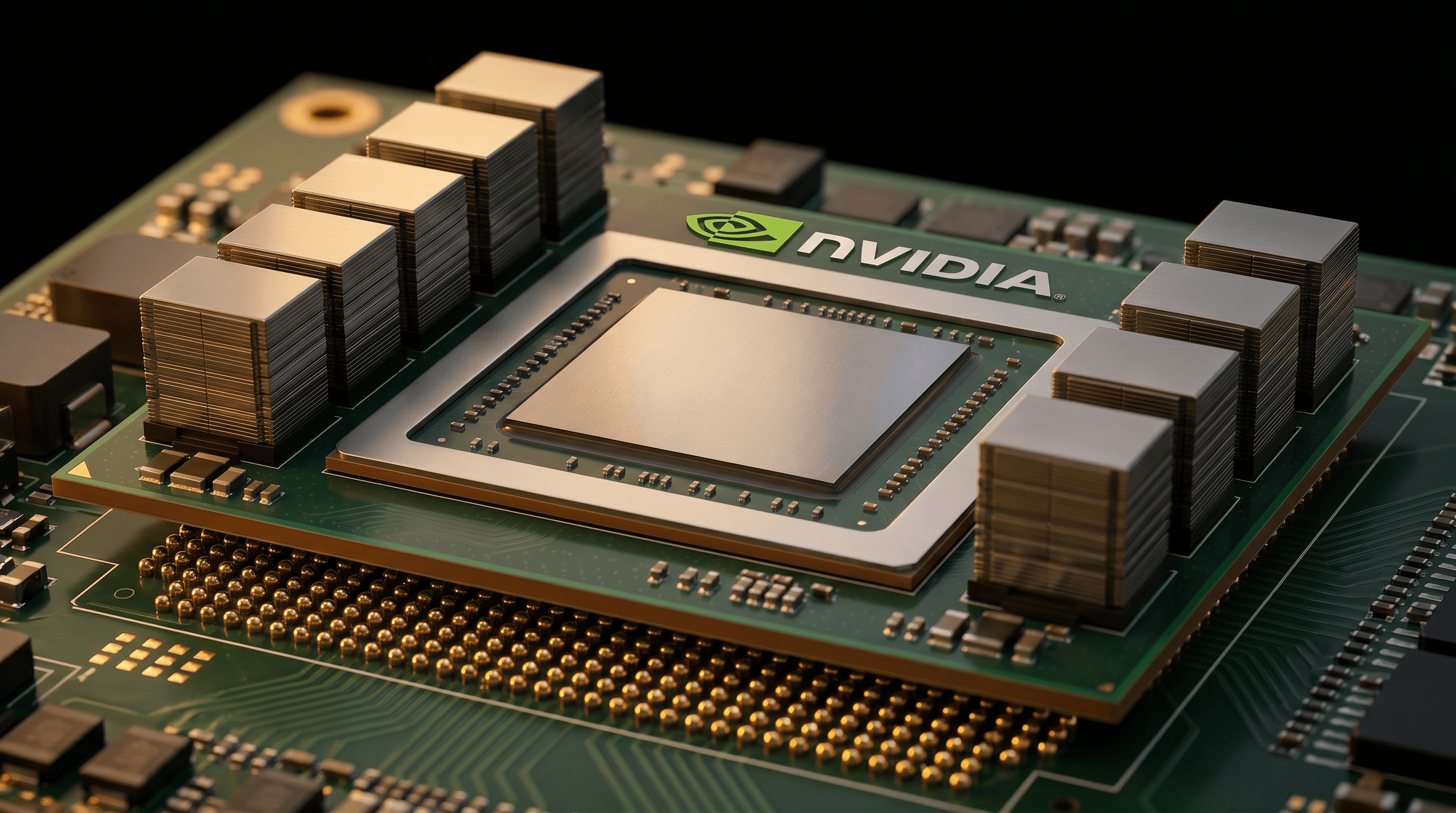
Micron (MU) Earnings and the 2026 AI Memory Supercycle
Micron's high-bandwidth memory is sold out for 2026 and DRAM prices have roughly doubled. Inside the AI memory supercycle - and the cycle risk.

MU ranks #23 of 33 · score 45. These 3 lead the sector:
- 1
 NVDANVIDIA CorporationAACDBB70
 - 2
 TSMTaiwan Semiconductor Manufacturing Company LimitedAACCBB70
 - 3
 OLEDUniversal Display CorporationDBBBCB68
Key Takeaways
- Micron's HBM capacity is effectively booked through 2026, turning a commodity into a scarce, priced-to-demand component.
- Fiscal Q3 guidance pointed to roughly $33.5B in revenue at a gross margin near 81% - extraordinary for a memory maker.
- NVIDIA (NVDA) and the AI server buildout are the demand engine; every next-gen accelerator needs stacks of HBM.
- The bull case is real, but memory has never permanently escaped its cycle - 2027 supply is the swing factor.
Micron (MU) just told Wall Street its high-bandwidth memory is sold out for all of 2026 - with half the year still to go. When a chipmaker famous for brutal boom-bust cycles runs out of supply a year ahead, something structural has shifted.
What Micron Just Told the Market
Micron reports fiscal Q3 2026 results after the close on June 24, and the setup is unusual. Management's own guidance from the prior quarter pointed to around $33.5 billion in revenue and a gross margin near 81% - a profitability level the memory industry rarely approaches.
The reason is high-bandwidth memory, or HBM - the stacked DRAM that sits beside AI accelerators. Micron has said its HBM output is effectively sold out for 2026, which means pricing is set by scarcity rather than spot-market commoditization. That is the opposite of how memory usually works.
For context, memory is historically the most cyclical corner of semiconductors. When demand booms, every producer adds capacity, supply floods in, and prices crater. HBM's capacity-reserved, multi-quarter contracts break that reflex - at least for now.
Why Does a DRAM Shortage Matter Now?
Because the shortage is the tightest in roughly 15 years, and it is showing up directly in pricing. Goldman Sachs pegged the 2026 DRAM supply-demand gap at about 4.9%, and contract prices jumped roughly 90% quarter-over-quarter in early 2026.
When a 5% supply gap translates into a near-doubling of contract prices, you are watching operating leverage in real time. In a supply-constrained memory market, a few points of shortage can swing margins by tens of points - which is exactly why Micron's gross-margin guide sits near 81%.
Industry forecasts reflect the same theme. Bank of America has described 2026 as a memory "supercycle," with global DRAM revenue projected to climb around 51% and the HBM market alone reaching roughly $54.6 billion - up about 58% year over year.
The squeeze is not limited to DRAM. NAND flash, used for storage, has seen similar pricing strength as AI data centers hoard capacity, with industry estimates pointing to NAND revenue growth around 45% in 2026. When both memory types tighten at once, the entire supply chain feels it.
This is also why memory names have been among the year's strongest performers. Micron shares have advanced roughly 141% in 2026, and the company crossed the $1 trillion market-cap mark earlier this year.
Winners and Losers in the AI Memory Chain
The supercycle is not just a Micron story. It ripples across the entire AI hardware stack, from the GPUs that consume HBM to the networking gear that ties servers together.
| Company | Role in the AI memory chain | 2026 setup |
|---|---|---|
| Micron (MU) | HBM + server DRAM supplier | Capacity sold out; margins near cycle peaks |
| NVIDIA (NVDA) | Buys HBM for AI accelerators | Demand engine; HBM is a cost input |
| Broadcom (AVGO) | Custom AI silicon + networking | Benefits from data-center buildout |
| AMD (AMD) | GPU challenger using HBM | Needs HBM allocation to compete |
| Arista (ANET) | Data-center networking | Scales with AI server deployments |
The clearest beneficiary is Micron (MU) itself, alongside the broader memory group. NVIDIA (NVDA) sits on the other side as a buyer - HBM is a rising cost input - but its demand is what makes the whole cycle run.
Further down the chain, Broadcom (AVGO), AMD (AMD), and Arista Networks (ANET) all scale with the same AI infrastructure wave. The pattern that matters: in 2026, the picks-and-shovels of AI moved one layer deeper - from the GPU to the memory stacked beside it.
It also explains why investors have rotated down the stack all year. As GPU valuations stretched, capital hunted for the next constrained input - and memory, long treated as a commodity afterthought, suddenly became the bottleneck that mattered most.
Is Micron Stock Still a Buy After Quadrupling?
Not a simple yes. After a roughly 141% run in 2026, much of the near-term good news is arguably priced in, and that is the central tension for new buyers.
The bull argument is that earnings are catching up to the price. If gross margins hold near 81% and HBM stays sold out, the forward multiple compresses as profits expand - a classic feature of the right side of a memory cycle.
The caution is valuation timing. Buying a deep cyclical after a sharp rally has historically been risky precisely when the numbers look best. This is where fundamental analysis earns its keep: the question is not whether this quarter is strong, but how much strength the market has already capitalized.
What to Watch in the June 24 Print
The headline revenue and EPS will matter, but the real signals sit in the commentary. Watch three things: HBM pricing and allocation for 2027, gross-margin durability, and any color on competitive supply from Samsung and SK Hynix.
2027 is the swing year. If management signals visibility into continued tight HBM supply into 2027, the cyclical-peak fears ease; if guidance turns cautious on 2027 pricing, the stock's cycle clock starts ticking.
Investors should also listen for capital-expenditure plans. Heavy capex to expand HBM is bullish for demand signals but is exactly what eventually reseeds the next oversupply. The memory industry has a long history of turning today's shortage into tomorrow's glut by building too much, too late in the cycle.
What Is the Bear Case?
The risk is that memory always reverts to type. Every prior memory boom - and there have been many - ended when capacity additions overshot demand and prices collapsed, taking margins down with them.
Several analysts and outlets have already flagged this. Reporting in 2026 has warned that HBM pricing could enter a correction phase after this year as competitors expand output, and that memory's boom-bust DNA has not been repealed - only delayed.
So the honest framing is a strong near-term setup against a well-known long-term hazard. The supercycle thesis is not that memory stopped being cyclical; it is that AI demand can keep HBM tight for longer than the bears expect - a bet on duration, not a repeal of the cycle.
For readers weighing the trade, pairing this with a broader view of investment strategies helps frame how much cyclicality belongs in a portfolio.
Ready to analyze these stocks yourself? Search any ticker on MainRatios to see valuations from 6 legendary investors - free.
See the full analysis of $MU
Live P/E chart, financials, and valuations from 6 legendary investors — free.
Analyze $MUFrequently Asked Questions
Micron is scheduled to report after the US market close on June 24, 2026. Management's prior guidance pointed to roughly $33.5 billion in revenue and a gross margin near 81%.