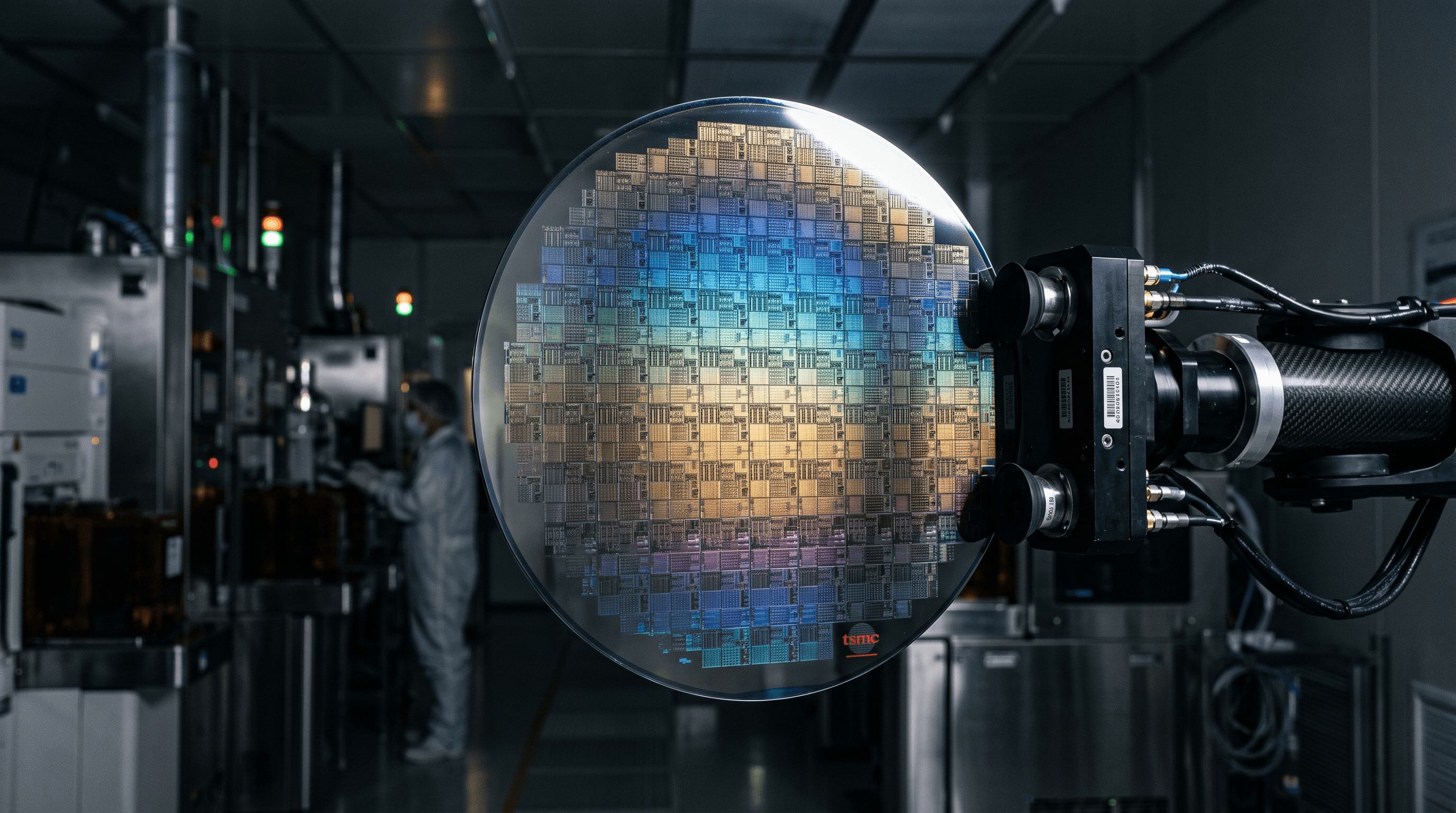
Why the 2026 Semiconductor Selloff Erased $1 Trillion
Broadcom's soft AI-chip outlook erased about $1 trillion in two sessions and dragged Nvidia, AMD and Micron lower. Here is what the chip rout actually signals.

Puntos clave
- [AVGO]'s soft AI-chip guidance, not a demand collapse, triggered a roughly $1 trillion two-day drawdown — investors re-rated duration risk, not current orders.
- Memory and networking names like [MU] and [MRVL] fell harder than logic leaders because they sit closest to the capex that is now being questioned.
- The Big-5 hyperscalers still guided to about $725 billion of 2026 AI infrastructure spend, so the bull case is intact on paper.
- The bear case is circularity: a chunk of AI revenue is vendors selling into each other's customers, and that loop can unwind quickly.
- A hot jobs print pushed the 10-year yield near 4.54%, and richly valued chips are the most rate-sensitive corner of the market.
A single cautious outlook from Broadcom (AVGO) erased roughly $1 trillion in US equity value across two sessions in early June 2026, pulling NVDA and the rest of the AI-chip complex down with it. The drop was not about one quarter — it was the market re-pricing how long the AI buildout can keep compounding.
What actually happened in early June 2026?
A guidance wobble, not a demand cliff. Broadcom (AVGO) posted solid numbers but signaled a softer near-term AI-chip outlook, and traders treated it as a read-through for the whole group.
Within two sessions the Nasdaq shed roughly 4% and about $1 trillion in market value evaporated. Micron (MU) fell around 6.3%, Marvell (MRVL) dropped close to 8%, and Advanced Micro Devices (AMD) slid about 6.3%.
When the highest-quality name in a crowded trade guides cautiously, investors stop asking "how big is the backlog?" and start asking "how long does this last?" That shift in the question is what re-prices an entire sector.
NVIDIA (NVDA) was not spared even though its own quarter was strong, with data-center revenue around $75.2 billion. The selloff was about the group's multiple, not any single print.
Why did one chip outlook drag down the whole sector?
Because the AI trade is priced for duration, not just demand. Chip multiples bake in years of capex growth, so any hint that the curve flattens hits the stock price far harder than the current quarter would justify.
The semiconductor supply chain is also tightly correlated. When the market doubts hyperscaler spending, it sells the memory makers, the networking suppliers, and the foundries together — even names with very different end markets.
That is why Qualcomm (QCOM) and Texas Instruments (TXN), which have only modest AI exposure, still traded lower on the same days. Correlation, not fundamentals, drives the first leg of a sector rout.
If you are new to reading these moves, our guide to fundamental analysis explains why valuation multiples amplify sentiment swings in high-growth stocks.
Winners and losers in the chip rout
Not every chip name is equally exposed. The table below groups recent leaders by how directly their revenue depends on the 2026 AI capex cycle.
| Stock | AI capex exposure | Two-session move | Why it matters |
|---|---|---|---|
| AVGO | High (custom AI silicon) | -3.8% | Outlook was the trigger |
| MU | High (HBM memory) | -6.3% | Closest to data-center demand |
| MRVL | High (interconnect) | -8.0% | Networking is capex-linked |
| AMD | Medium-high (GPUs) | -6.3% | Sentiment, not numbers |
| TXN | Low (analog/industrial) | Lower | Correlation, not fundamentals |
The cleanest tell in a sector selloff is dispersion: when low-exposure names fall as hard as high-exposure ones, the move is driven by fear rather than by any change in the actual order book. That gap usually closes within weeks.
Infrastructure suppliers like Vertiv (VRT) and Arista Networks (ANET) also wobbled, because power and networking gear are the second derivative of every new data-center build.
Is the AI capex boom actually over?
Not on the spending guidance. The five largest hyperscalers still pointed to roughly $725 billion of combined 2026 AI infrastructure investment, and several raised their full-year budgets during the prior earnings season.
Taiwan Semiconductor (TSM), which manufactures most advanced AI silicon, has not signaled a demand reversal either. The hard data still describes a buildout in progress, not a bust.
The risk is timing, not direction. A boom can stay intact for years while the stocks that price it correct by 20% or more along the way — duration risk and demand risk are different animals.
What should investors watch next?
Watch the 10-year Treasury yield first. A stronger-than-expected May jobs report — around 172,000 new positions with unemployment near 4.3% — pushed the benchmark yield close to 4.54%, and rising rates compress the multiples that growth chips depend on.
Then watch hyperscaler capex commentary at the next round of earnings. If the cloud giants trim budgets, the bear case gains real evidence; if they hold, this looks like a sentiment-driven dip.
Finally, watch dispersion. When low-exposure analog names recover faster than the AI-levered leaders, that is the market separating fear from fundamentals again.
The counter-argument: why the bears may be early
Critics of the AI trade argue the demand is partly circular — chipmakers, cloud providers, and AI startups are financing each other, so reported revenue may overstate true end-user adoption. That is a legitimate risk worth tracking.
But "early" and "wrong" are not the same. The buildout has repeatedly outrun skeptics, and betting against capex that is already contracted has been a losing trade for two years.
The honest position is humility on timing. A correction inside a structural boom feels identical to the start of a bust until, in hindsight, it doesn't — which is exactly why position sizing matters more than conviction here.
For the long-term investor, the practical move is to value each chip name on its own cash flows rather than the sector narrative. Compare how the legendary investor models score [NVDA], [AMD], and [AVGO] before deciding whether the rout is a gift or a warning.
Ready to analyze these stocks yourself? Search any ticker on MainRatios to see valuations from 6 legendary investors - free.
Mira el análisis completo de $AVGO
Gráfico P/E en vivo, finanzas y valuaciones de 6 inversores legendarios — gratis.
Analizar $AVGOFrequently Asked Questions
No. AVGO posted solid results but issued a softer near-term AI-chip outlook. The selloff was a reaction to the forward guidance and what it implied for the whole sector, not to the reported quarter.