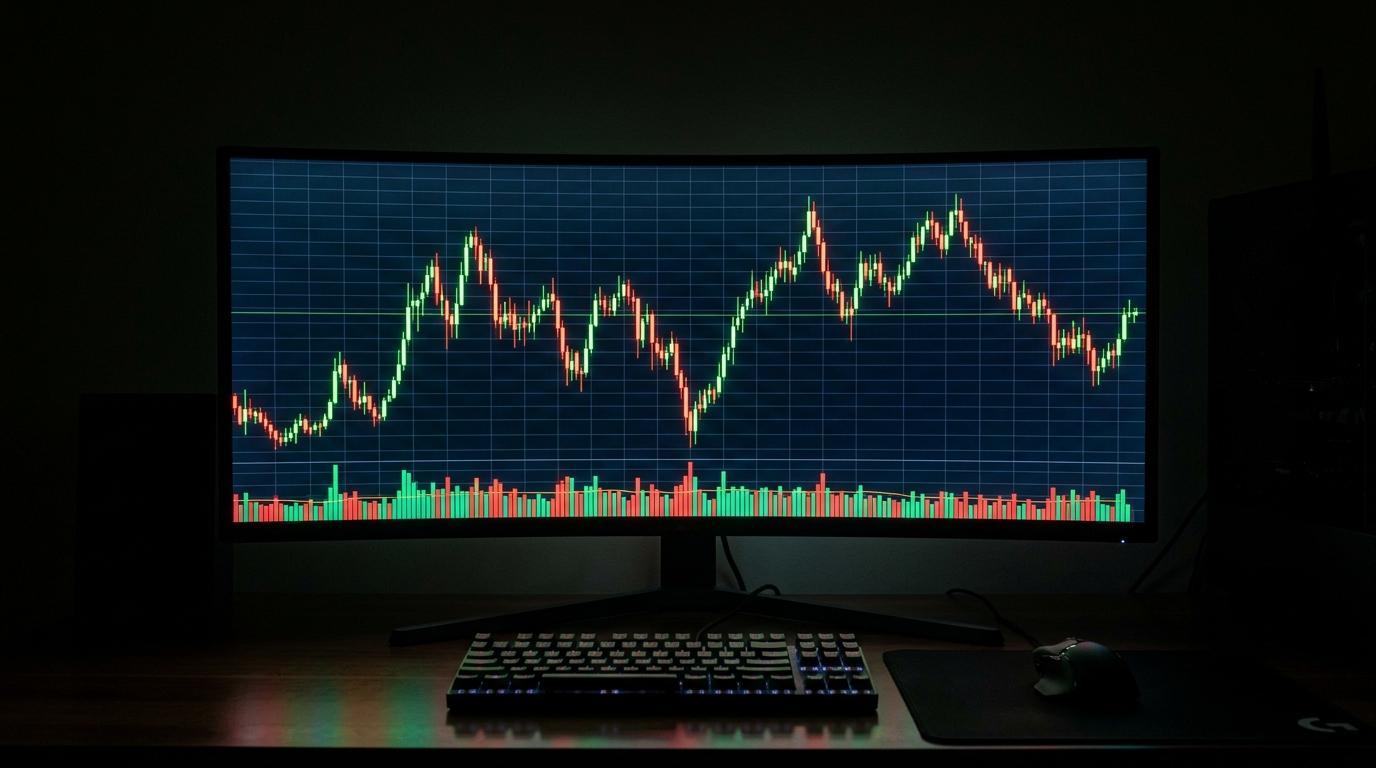
Roughly 80% of professional momentum traders run some version of MACD on their charts, yet most retail investors who learn it use it backwards. The signal that matters is not the cross — it is the divergence. Get that one distinction right and MACD becomes the most useful momentum tool you will ever read.
What Is the MACD Indicator?
In one sentence: MACD plots the gap between two exponential moving averages of price, then overlays a slower average of that gap to generate signals.
The classic settings are 12-period EMA minus 26-period EMA, with a 9-period EMA of the difference acting as the "signal line". When the MACD line crosses above the signal line, traders read it as bullish momentum. When it crosses below, bearish. The histogram shows the gap between the two — the bigger the bar, the stronger the momentum.
Gerald Appel introduced MACD in the late 1970s for commodities traders working off paper charts. The fact that it survived the transition to electronic markets, multi-timeframe trading and algorithmic execution is unusual. Most indicators of that era are now considered noise.
How Does MACD Actually Work?
It works by translating two pieces of trend information into one momentum reading. Fast EMA captures recent price action; slow EMA captures the underlying trend. The gap between them is your real-time read on whether momentum is accelerating or decelerating.
Three components matter:
- MACD line: 12-EMA minus 26-EMA. This is the raw momentum.
- Signal line: 9-EMA of the MACD line. This smooths out the chop.
- Histogram: MACD minus signal. Positive bars = momentum building; negative bars = momentum bleeding.
The cross of MACD above signal is the textbook bullish trigger. The cross below is the textbook bearish trigger. Most retail traders stop there. Professionals do not — they read the histogram for early warnings, and they read divergences for the highest-quality trades.
What Are the Three Signals MACD Generates?
Three signals — and they are not equal in quality.
Signal 1: Crossover. MACD crosses signal line. This is the most common trigger but also the lowest-quality one because by the time it fires, the move is often already half-done. Best used as confirmation, not a standalone entry.
Signal 2: Centerline cross. MACD crosses above zero (bullish) or below zero (bearish). This signals a regime change in the underlying trend. Stronger than a simple crossover but lags more.
Signal 3: Divergence. Price makes a new high but MACD does not — bearish divergence. Or price makes a new low but MACD does not — bullish divergence. This is the highest-quality MACD signal and the one most retail traders ignore. Divergence is what fooled lesser traders into staying long NVDA tops or shorting JPM bottoms over multiple cycles.
| Signal Type |
Reliability |
Lag |
Best Use |
| MACD/Signal Crossover |
Low-medium |
Moderate |
Trend confirmation |
| Centerline Cross |
Medium |
High |
Regime change |
| Bullish/Bearish Divergence |
High |
Low |
Reversal setups |
| Histogram contraction |
Medium |
Low |
Momentum exhaustion |
| Histogram expansion |
Medium |
Low |
Trend acceleration |
Real Examples: MACD in 2026 Mega-Caps
Apply MACD to four large-caps and the differences jump out.
On Apple (AAPL), the MACD generated a bullish centerline cross in early February 2026, holding above zero through most of Q1. Buy-and-hold investors did not need it; trend traders used it as the green light to add on dips.
On Microsoft (MSFT), MACD has stayed firmly positive since early 2025 — almost too clean. When an indicator never gives a counter-signal in a strong uptrend, it loses information value. That is normal in a one-way trend.
On Nvidia (NVDA), MACD divergences caught the August 2025 pullback and the November 2025 bounce. Price made a marginal new high in August while MACD made a lower high — classic bearish divergence. The stock dropped roughly 18% over the next ~14 trading sessions.
On JPMorgan (JPM), MACD has been less informative because the stock trades on macro inputs (yield curve, credit spreads) more than pure technical momentum. That is the cost of using MACD: it works best on stocks where flow and sentiment dominate, not stocks where macro dominates.
What Are the Most Common MACD Mistakes?
Mistake 1: trading every cross. A textbook crossover on a sideways stock generates roughly 60-70% false signals. Always pair MACD with a trend filter — if the 50-day moving average is flat, the MACD cross is basically noise.
Mistake 2: using default settings on all timeframes. The 12/26/9 default was calibrated for daily bars. On 1-hour intraday charts, that setting is too slow. On weekly charts, it can be too fast. Tune to your timeframe.
Mistake 3: ignoring the histogram. The histogram is often the earliest signal. When the bars are contracting (still positive but shrinking), momentum is bleeding even before the actual cross fires. Pros watch the histogram first, the cross second.
Mistake 4: confusing MACD with MACD-H or MACD-Wilder. Different platforms compute it slightly differently. Always check what your charting tool is actually plotting before drawing conclusions. Combine MACD with proper technical analysis frameworks rather than trading it in isolation.
When NOT to Use MACD
Avoid MACD in three scenarios.
On illiquid stocks. Price needs continuous flow to generate clean EMAs. Names trading under ~500K daily shares produce gappy charts where MACD reads are unreliable.
On macro-driven names. Bank stocks like BAC and WFC trade on Fed expectations and credit spreads, not chart momentum. MACD signals on these names get overwhelmed by macro news in roughly 40-50% of cases.
During earnings windows. A 5-10% earnings gap will mechanically distort EMAs for the next ~10-15 sessions, generating false divergences. Either skip MACD around earnings or wait for the dust to settle before trusting the signal.
Pro Tips: How Institutional Traders Actually Use MACD
Layer it with one other indicator. The most common combo is MACD + RSI: MACD tells you momentum direction, RSI tells you whether you are overbought or oversold. When both align, the signal is materially stronger.
Use weekly MACD as a regime filter. If the weekly MACD is positive, only take long signals on the daily chart. If the weekly is negative, only take shorts. This single rule eliminates roughly 70% of false signals according to multiple back-tests.
Watch for histogram momentum BEFORE the cross. The histogram peaks before the MACD/signal cross. Early-stage histogram contraction is your real warning that momentum is about to reverse — usually 3-5 bars ahead of the actual signal flip.
Combine technical reads with the super-investors quality framework. Stan Druckenmiller has talked publicly about layering technical signals on top of fundamental conviction — MACD divergences are one of the technical inputs he reportedly weights.
Ready to analyze these stocks yourself? Search any ticker on MainRatios to see valuations from 6 legendary investors - free.