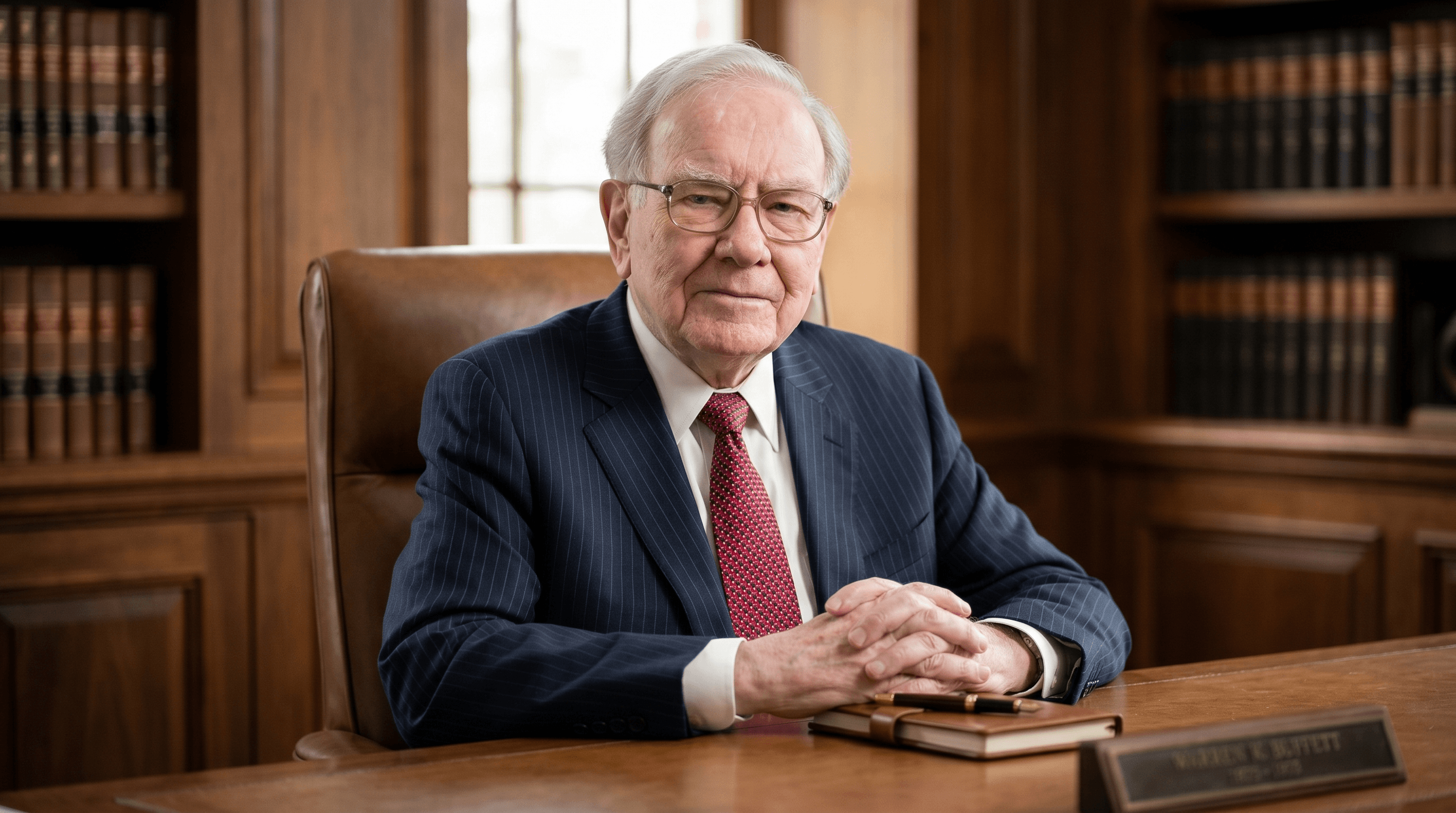
Philip Fisher: The Scuttlebutt Method That Shaped Buffett
Buffett called himself '85% Graham, 15% Fisher.' The 15% — Philip Fisher's scuttlebutt method — is what built Berkshire's growth-at-quality engine.

Puntos clave
- Philip Fisher (1907-2004) pioneered "scuttlebutt" — talking to industry insiders to evaluate a business beyond financial filings
- His 1958 book "Common Stocks and Uncommon Profits" listed 15 points to evaluate before buying — most still apply in 2026
- Fisher held Motorola (a Texas Instruments-style precursor) for over 30 years, riding it from a small radio company to a tech giant
- His philosophy: own concentrated positions in growth companies you understand deeply; do almost nothing once you own them
- Buffett, Munger, Lynch, and modern compounder investors all cite Fisher as a foundational influence
Warren Buffett once described himself as "85% Graham, 15% Fisher." But the 15% — Philip Fisher's idea that you should talk to suppliers, customers, and competitors before buying a stock — is what built Berkshire (BRKB)'s growth-at-quality engine.
Origin Story: from 1929 survivor to Wall Street outsider
Fisher graduated from Stanford's Graduate School of Business in 1928 — at age 21 — and joined a San Francisco bank as a security analyst. He was at the desk during the 1929 crash and the brutal grind of the Great Depression that followed. That experience taught him a lesson he held for the rest of his life: the cheapest stock in the market is rarely the safest, and the safest is rarely the cheapest.
In 1931, in the depths of the Depression, he opened his own firm — Fisher & Company — with three clients and a budget that barely covered rent. Most peers thought it was a terrible time to start an investment firm. Fisher reasoned the opposite: a contrarian launch in a depressed market was when the best businesses could be acquired for the lowest prices.
He stayed independent his entire career. Fisher & Company never had more than a handful of clients. He believed concentration on a small number of high-conviction positions was a feature, not a flaw, of the strategy.
Philosophy: scuttlebutt and 15 points
The core of Fisher's process was what he called "scuttlebutt" — gathering qualitative information from people who actually know a company. Suppliers. Customers. Former employees. Competitors. The premise was that financial filings tell you what already happened; scuttlebutt tells you what is about to happen.
He laid out the framework in his 1958 book "Common Stocks and Uncommon Profits," which became required reading at most modern investment firms. The book listed 15 points to evaluate before buying:
- Does the company have products with sufficient market potential for several years of substantial sales growth?
- Does management have the determination to keep developing new products?
- How effective is the company's R&D effort relative to size?
- Does the company have an above-average sales organization?
- Does the company have a worthwhile profit margin?
- What is the company doing to maintain or improve profit margins?
- Does the company have outstanding labor and personnel relations?
- Does the company have outstanding executive relations?
- Does the company have depth in its management?
- How good are the company's cost analysis and accounting controls?
- Are there other industry-specific factors that give clues to how outstanding the company is?
- Does the company have a long- or short-range outlook?
- Will future growth require equity financing that dilutes existing holders?
- Does management talk freely to investors when things are going well — and when they're going poorly?
- Does the company have unquestionable integrity?
The list is timeless because it focuses on qualitative quality rather than transient metrics.
Five key principles every investor can use
1. Concentrate in your best ideas. Fisher typically held 10-30 stocks. He believed diversification beyond that point was an admission that you didn't really understand any of your positions. His son Ken Fisher (founder of Fisher Investments) later wrote that Phil's portfolio sometimes had a single position worth more than 25% of total assets.
2. Hold for decades, not quarters. Fisher famously held Texas Instruments and Motorola for over 30 years. He believed taxes and trading costs compound against you, so the rational move is to find a great business and do almost nothing. Lynch and Buffett both cite this discipline as foundational.
3. Do scuttlebutt before buying — not after. Most investors buy first and research second. Fisher reversed that. Talk to ten industry insiders before committing capital. By the time you buy, you should know more about the business than the average sell-side analyst.
4. Quality beats price more often than price beats quality. Fisher was willing to pay above-average multiples for above-average businesses. He felt the cost of being wrong on a great business was far smaller than the cost of being wrong on a mediocre one. This is the philosophical line that connects Fisher → Munger → Buffett's evolution at Berkshire.
5. Sell only when the original thesis breaks. The three reasons Fisher sold: (a) you made a mistake on the original analysis, (b) the company changed for the worse, (c) you found a meaningfully better idea. Note that "the stock went up a lot" is NOT on the list.
Famous quotes from Fisher
"The stock market is filled with individuals who know the price of everything, but the value of nothing."
"If the job has been correctly done when a common stock is purchased, the time to sell it is — almost never."
"Conservative investors sleep well."
"I don't want a lot of good investments; I want a few outstanding ones."
"It is not the profitability of a business at any given moment that matters most, but the profitability over the next five to ten years."
These map almost directly to Buffett's later articulations. The intellectual lineage is undeniable.
Notable holdings: from Motorola to a 30-year hold
Fisher's most famous position was Motorola, which he bought in 1955 and held until his death in 2004. Across that span the company transformed from a car-radio manufacturer into a semiconductor and telecom giant.
His other notable long-term positions included Texas Instruments, which became a poster child for his "outstanding R&D capability" filter, and Dow Chemical (now Dow), held through multiple cycles for the dividend-plus-growth profile.
While Fisher didn't write directly about today's mega-caps, his framework maps cleanly onto what we now call "compounders":
| Modern Ticker | Fisher Filter Match |
|---|---|
| MSFT | Outstanding R&D, durable management, integrity |
| AAPL | Loyal customers, premium margins, capital discipline |
| V | Near-monopoly economics, recurring revenue |
| COST | Customer-first culture, deep employee relations |
| BRKB | Long-range outlook, integrity, talent depth |
The exercise isn't to claim Fisher would have owned each of these — it is to show how a 1958 framework applies to 2026 businesses.
Performance: how the "do nothing" approach paid off
Fisher's clients were private and his firm never disclosed audited performance. But the qualitative evidence is extensive. His Motorola position alone is reported to have compounded at well above market rates across five decades. Several positions held for 20+ years ended up worth multiples of their original cost basis.
Compounding math explains the rest. A position held for 30 years at 12% annual return turns $10,000 into roughly $300,000. The same position held 5 years and traded turns into roughly $17,500 even before tax friction. Fisher's edge was less about picking better than other analysts and more about not selling.
The few clients he had paid him handsomely. Many remained with the firm for 40+ years.
What can investors learn from Fisher today?
Three practical lessons remain.
First, do qualitative research before quantitative. A spreadsheet can tell you what a business looks like; conversations with suppliers, customers, and former employees tell you what it actually is. Modern equivalents: industry forums, podcast interviews with former executives, conference call Q&A patterns over multiple quarters.
Second, concentrate when you have real conviction. Holding 100 stocks is closet indexing with extra steps. Fisher's logic — that a 30-stock portfolio still allows 3% positions to drive meaningful returns — applies as well in 2026 as in 1958.
Third, accept that doing nothing is hard but profitable. The single most expensive habit for most investors is selling winners too early. Fisher's discipline was to define the thesis at purchase and stick to it until the thesis broke — not until the chart looked wobbly.
Critics argue the scuttlebutt method is harder to execute today: insider trading regulations, Reg FD, and information density mean qualitative edges are scarcer. There is truth there. But the underlying principle — that durable competitive advantage and management quality beat any single quarter — is more, not less, relevant in an algorithm-driven market.
For more on this lineage, see our profiles of Charlie Munger and Berkshire's mental models and our overview of super investors and their strategies.
Practical takeaways for 2026 investors
The Fisher checklist still works. To use it today:
- Pick a candidate company you already think you understand
- Try to fail each of the 15 questions in order
- Where you can't find a confident answer, do the scuttlebutt — call former employees on LinkedIn, listen to a decade of conference calls, read employee reviews on Glassdoor
- Only buy when at least 12 of 15 are confidently "yes"
- Hold for at least 5 years unless one of Fisher's three sell rules clearly triggers
The framework rejects more candidates than it accepts. That is by design. Fisher believed most public companies are NOT investable — and that the willingness to say "no" 95% of the time is what differentiates the long-term winners.
Ready to analyze these stocks yourself? Search any ticker on MainRatios to see valuations from 6 legendary investors - free.
Mira el marco PEG de Peter Lynch en acción
Valuaciones ajustadas por crecimiento que revelan lo que Lynch llamaría barato.
Ver las valuaciones de LynchFrequently Asked Questions
Indirectly. Buffett read "Common Stocks and Uncommon Profits" in the late 1950s and reportedly visited Fisher in person. Buffett has called himself "85% Graham, 15% Fisher" — but the Fisher influence shows up most clearly in his evolution toward owning quality compounders rather than statistical bargains.