George Soros: The Man Who Broke the Bank of England
George Soros compounded the Quantum Fund at roughly 30% annually and made about $1B shorting sterling in 1992. Here is his philosophy and portfolio today.
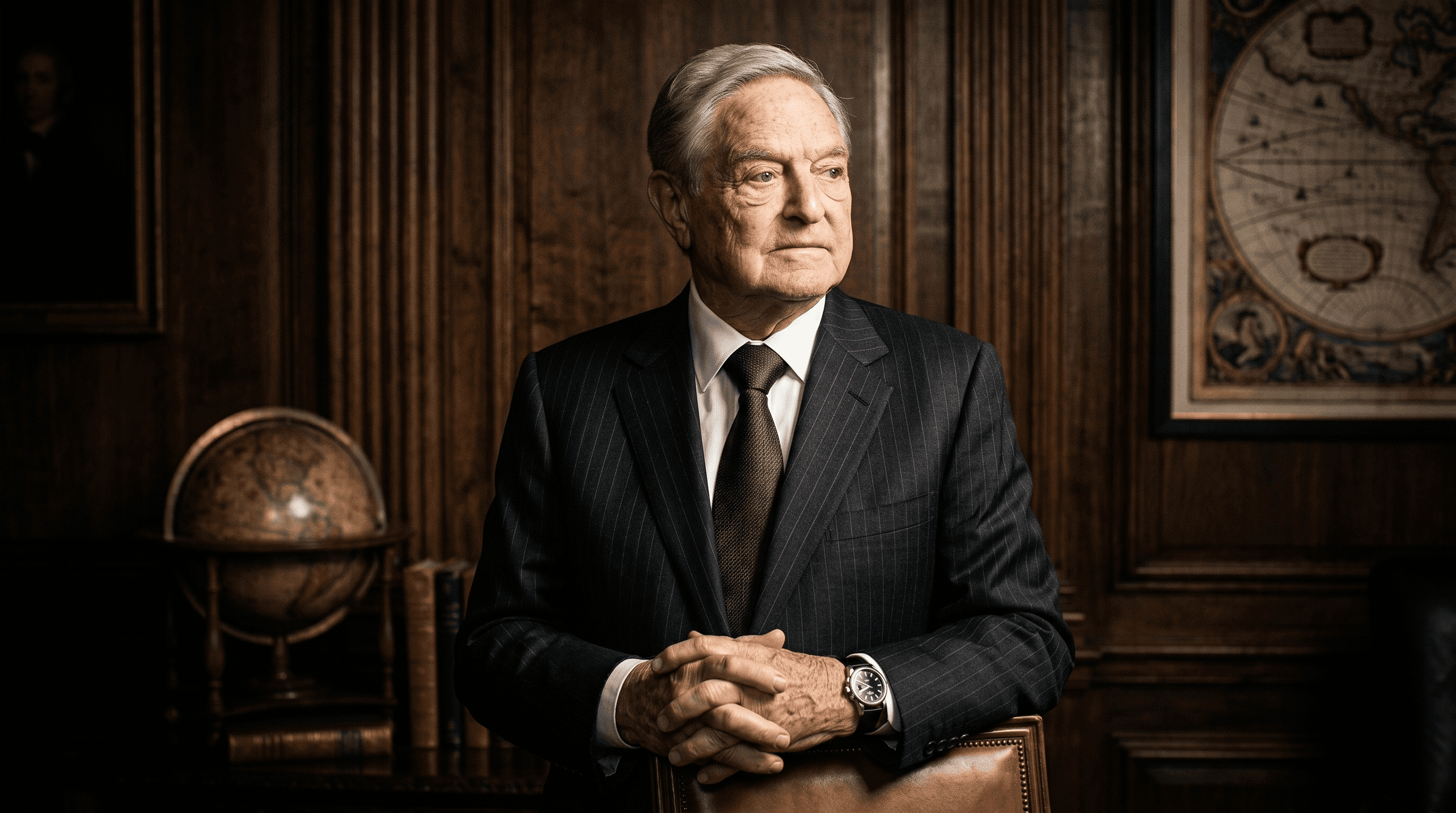
Key Takeaways
- Soros compounded the Quantum Fund at approximately 30% annualized over roughly 30 years
- His "theory of reflexivity" argues markets and fundamentals shape each other — not one-way causality
- The 1992 GBP short earned the Quantum Fund around $1B in a single day
- Modern Soros Fund Management holds blue chips like Alphabet (GOOGL) and Amazon (AMZN) alongside opportunistic bets
- Counter-argument: his macro style is hard to replicate without institutional access to leverage and policy insights
On September 16, 1992 — "Black Wednesday" — George Soros reportedly made roughly $1 billion in a single day shorting the British pound and forced the Bank of England out of the European Exchange Rate Mechanism. Today Soros Fund Management still concentrates bets on Alphabet (GOOGL), Amazon (AMZN), and Nvidia (NVDA).
Who is George Soros?
George Soros was born in Budapest in 1930. He survived Nazi occupation as a teenager, emigrated to London in 1947, and graduated from the London School of Economics in 1952. His early mentor was philosopher Karl Popper, whose work on falsification and open societies deeply influenced Soros's investment philosophy.
He moved to New York in 1956 and worked as an arbitrage trader before launching his own firm in 1969. That firm eventually became the Quantum Fund — one of the highest-returning hedge funds of the 20th century.
The critical point in his career was 1969 to 1973, when he and partner Jim Rogers built the Quantum Fund into a global macro powerhouse. Soros was willing to bet big when conviction was high — a habit that later defined the sterling trade.
What is the theory of reflexivity?
Reflexivity is Soros's central intellectual contribution. The idea is that market prices do not just reflect fundamentals — they also shape them. Rising stock prices can lower a company's cost of capital, which improves fundamentals, which justifies higher prices, and so on.
The opposite is true on the downside. Falling prices can trigger credit tightening, which worsens fundamentals, which justifies further price declines. This feedback loop creates boom-bust cycles that efficient-market theory cannot explain.
Soros argued that investors should focus on identifying these self-reinforcing cycles early and positioning accordingly. The trader's job is not to predict fundamentals but to spot the moments when the market's reflexive grip becomes unstable.
Five Core Principles Behind Soros's Returns
- Bet big when conviction is high: Soros famously told trader Stanley Druckenmiller to go "for the jugular" on the sterling trade. Position sizing is where great trades become great portfolios.
- Markets are always wrong — just figure out how: Every market has a dominant narrative. Identify the flaw in that narrative and lean against it.
- Survival first: Soros famously cut losses quickly. "It is not whether you are right or wrong that is important, but how much money you make when you are right and how much you lose when you are wrong."
- Reflexivity is asymmetric: The feedback loop works both ways, but human psychology amplifies downside spirals. Be cautious about catching falling knives in reflexive bear markets.
- Ignore benchmarks, target absolute returns: The Quantum Fund was measured against cash, not the S&P 500. That freed Soros to hold concentrated bets and go to cash entirely when conviction faded.
Famous Quotes
- "It is not whether you are right or wrong that is important, but how much money you make when you are right and how much you lose when you are wrong."
- "Markets are constantly in a state of uncertainty and flux, and money is made by discounting the obvious and betting on the unexpected."
- "The worse a situation becomes, the less it takes to turn it around, and the bigger the upside."
- "Once we realize that imperfect understanding is the human condition, there is no shame in being wrong, only in failing to correct our mistakes."
Notable Trades and Holdings
| Year / Trade | Result | Context |
|---|---|---|
| 1992 - Short GBP | ~$1B in one day | Bank of England forced out of ERM |
| 1997 - Short Thai baht | Large profit | Asian financial crisis |
| 2007-2008 - Short housing | Returned ~$1.5-2B to fund | Ahead of global financial crisis |
| 2013 - Short yen | Reportedly ~$1B | Abenomics currency regime |
| 2020-2026 - Long tech | Portfolio core | Late-stage cycle positioning |
As of recent 13F filings, Soros Fund Management's publicly disclosed equity portfolio includes core holdings in Alphabet (GOOGL), Amazon (AMZN), Meta Platforms (META), Apple (AAPL), and Nvidia (NVDA), plus selected positions in AMD (AMD), Qualcomm (QCOM), Disney (DIS), and Netflix (NFLX). Portfolio turnover is high — the fund rotates aggressively around macro theses.
In the financials complex, disclosed positions have historically included JPMorgan (JPM) and Bank of America (BAC), with healthcare exposure through Johnson & Johnson (JNJ) and Eli Lilly (LLY) at various points.
Performance: 30% Annualized Over Decades
Soros's Quantum Fund returned approximately 30% annualized from 1969 through the early 2000s. A $1,000 investment in 1969 would have compounded to well over $4 million by 2000 — before accounting for management and performance fees.
Those returns reflect an era of global macro opportunity, loose currency regimes, and far less crowded trades. Replicating that performance today is effectively impossible given the flood of capital now chasing similar strategies. The lessons, however, remain applicable.
How Does Soros Compare to Buffett?
Completely different. Warren Buffett's framework is microeconomic: buy wonderful businesses at fair prices and hold for decades. Soros's framework is macroeconomic: identify reflexive market cycles and position aggressively around them.
Buffett rarely shorts, rarely trades currencies, and rarely uses leverage. Soros built his fortune on all three. Both outperformed dramatically, which tells you there is no single correct style — there is the style that fits your temperament and skill set.
Our super investors guide walks through how six legendary frameworks — from Buffett and Graham to Lynch and Soros — differ in philosophy.
Is the Soros Style Replicable for Retail Investors?
Mostly no, but the principles translate. The specific mechanics — levered currency bets, Quantum Fund-scale institutional access to policy signals — are out of reach for retail investors.
The principles, however, are universal:
- Size up when conviction is high
- Cut losses quickly when the thesis breaks
- Think about reflexivity: when is rising price helping fundamentals (Nvidia 2024) versus when is it stretching them (Nvidia 2026)?
- Ignore benchmarks in favor of absolute outcomes
For equity investors, a useful application is to notice when sentiment is driving fundamentals rather than the other way around. When a company's stock price is enabling acquisitions or easing its cost of capital, the reflexive spiral is positive. When falling prices are triggering downgrades and ratings actions, the spiral is negative and painful.
Lessons for Your Portfolio
- Study macro context: Even fundamental stock pickers should understand the regime — rates, currency, credit spreads — that their equities sit inside.
- Practice position sizing: The difference between a great year and an average year is often a single high-conviction position sized boldly.
- Cut losses fast: When a thesis breaks, Soros exits. Retail investors often double down on losers out of ego.
- Look for reflexivity: Self-reinforcing loops in both directions are where outsized returns live.
- Be intellectually flexible: Soros was famous for changing his mind publicly when new evidence contradicted his thesis.
The Counter-Argument: Why Soros's Style Has Limits
Soros himself has acknowledged that global macro is a dwindling opportunity set. The crowding of the strategy, the reduced volatility of developed-market currencies, and the rise of algorithmic trading all cap the kind of asymmetric trades that made his 1992 fortune.
For modern investors, the more useful takeaway is not "short currencies" but "bet big when the mismatch between narrative and fundamentals is obvious." That discipline applies in any market — stocks, bonds, commodities, or even single-name equities.
If you want to study fundamental investing approaches that scale more readily to a retail portfolio, see our investment strategies guide. And for a direct Soros vs Buffett comparison with more detail, the fundamental analysis primer is a useful anchor.
Ready to analyze these stocks yourself? Search any ticker on MainRatios to see valuations from 6 legendary investors - free.
See the full analysis of $GOOGL
Live P/E chart, financials, and valuations from 6 legendary investors — free.
Analyze $GOOGLFrequently Asked Questions
Soros stepped back from day-to-day management years ago. Soros Fund Management is now run by his son Alex Soros and a professional team, though the fund continues to invest using the macro and reflexivity principles he established.