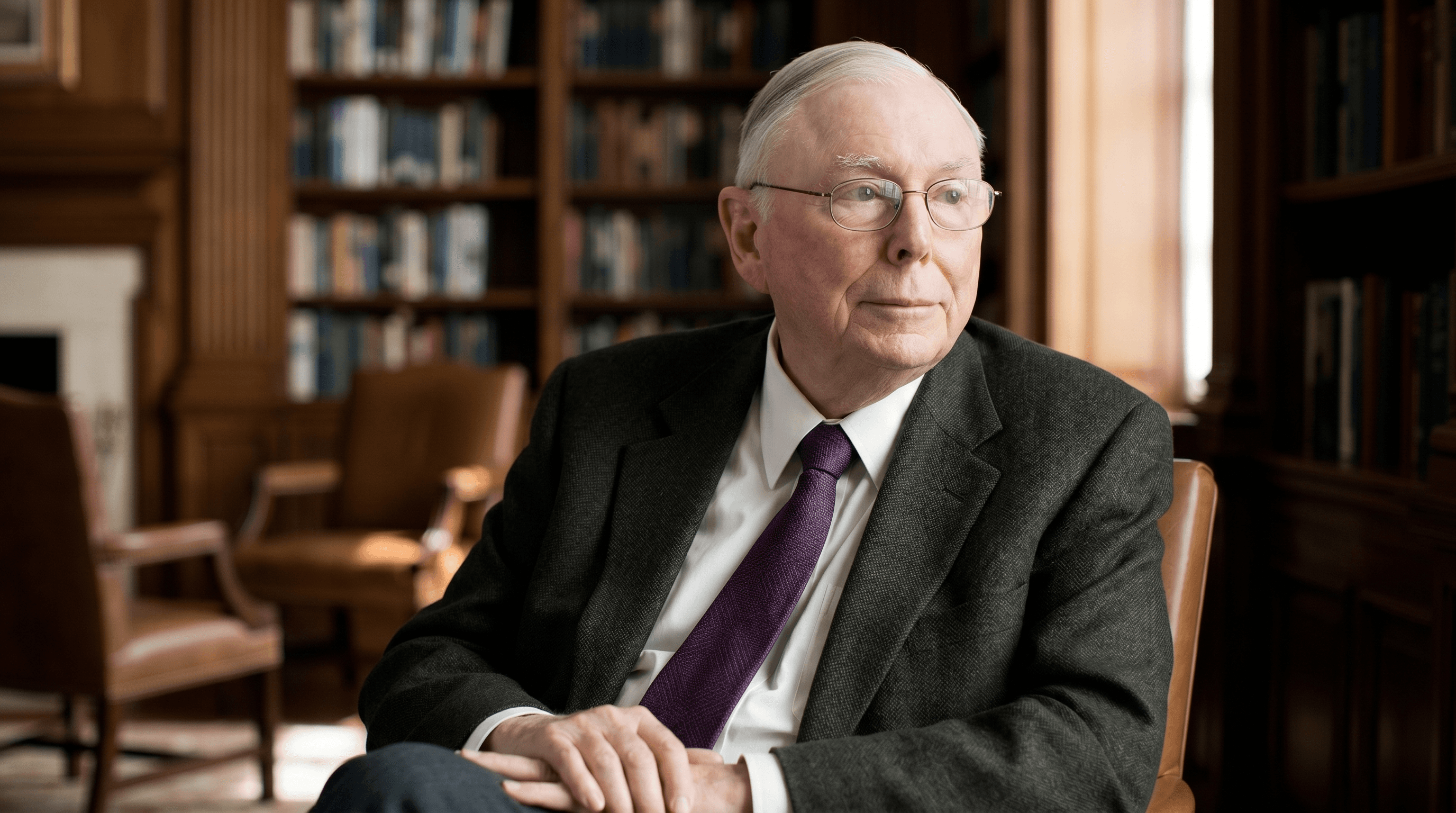
Charlie Munger once said his investing edge was not intelligence but "the constant search for ways to be less stupid". That single sentence rewired Berkshire Hathaway and made BRKB one of the great compounding stories of the 20th century — and it still works in 2026.
Origin Story: From Lawyer to Berkshire Vice Chairman
Charles Thomas Munger was born in 1924 in Omaha, Nebraska — the same hometown as Warren Buffett, though they did not meet until 1959. Munger studied math at the University of Michigan, served in the U.S. Army Air Corps during World War II, and earned a Harvard Law degree in 1948 without an undergraduate diploma — Harvard waived the requirement after his commanding officer wrote a letter of recommendation.
Munger built a successful Los Angeles law firm before pivoting to investing in the early 1960s. His Wheeler, Munger & Co. partnership compounded at roughly 19% annually from 1962 to 1975, before he wound it down and focused full time on Berkshire Hathaway as Buffett's vice chairman.
The partnership with Buffett ran for over six decades. Munger died in November 2023 at age 99, and his frameworks remain core to how Berkshire operates today.
What Was Munger's Investing Philosophy?
Munger's core argument was that investing is a multidisciplinary problem, not a financial one. He called the toolkit a "latticework of mental models" — concepts borrowed from biology (evolution, ecosystems), psychology (incentive bias, social proof), physics (thermodynamics, critical mass), economics (network effects, scale advantages), and history (regression to the mean, base rates).
The reasoning: any specific industry or company exists at the intersection of multiple forces, and an investor relying on a single discipline (say, accounting) will systematically misread businesses where the dominant force is a different discipline (say, behavioral psychology in consumer brands).
For fundamental-analysis practitioners, this is the upgrade from "read the 10-K" to "understand why customers behave the way they do, why management is incentivized the way it is, and why competitors cannot copy what works".
What Are Munger's Five Core Principles?
1. Buy wonderful businesses at fair prices. This was the philosophical pivot Munger forced on Buffett in the 1970s. Graham-style "cigar butt" investing — buying mediocre businesses below liquidation value — does not scale. Owning truly great businesses for decades does. The AAPL position Berkshire built between 2016 and 2019 is the template.
2. Use inversion. Ask "how could this go catastrophically wrong?" before asking "how do we win?". Munger borrowed this from the German mathematician Carl Jacobi, who advised "invert, always invert". Most investors look for reasons a thesis works; Munger looked for reasons it fails first.
3. Think in mental models. Build a working knowledge of roughly 80–100 core concepts across multiple disciplines. Apply them as a checklist when analyzing any new situation. Most analytical errors come from missing models, not from missing data.
4. Concentrate when conviction is real. Munger ran extreme concentration — at his Daily Journal Corp portfolio, three positions drove most of the returns. The implication: if you cannot identify three businesses worth owning for 20 years, you should not be picking individual stocks at all.
5. Avoid stupidity, not seek brilliance. "It is remarkable how much long-term advantage people like us have gotten by trying to be consistently not stupid, instead of trying to be very intelligent." This is the single most underappreciated piece of investing advice in modern markets.
Famous Quotes That Capture the Philosophy
Munger was a quotable thinker, partly by design. Three of his most-cited lines:
"The big money is not in the buying or the selling, but in the waiting."
"Show me the incentive and I will show you the outcome."
"Take a simple idea and take it seriously."
The quotes are simple. The discipline to apply them across decades is the hard part.
What Were Munger's Notable Holdings?
Munger's signature trades — the ones he is associated with intellectually if not always personally — read like a roll call of compounding-machine investments. The table below shows the businesses he influenced or championed at Berkshire and at his Daily Journal portfolio:
| Stock |
Berkshire / DJCO Position |
Why Munger Liked It |
| AAPL |
Berkshire (peak ~$170B) |
Sticky ecosystem, brand moat, capital-light |
| KO |
Berkshire ($25B+) |
Distribution moat, brand loyalty, global scale |
| AXP |
Berkshire (~$30B) |
Network effects, premium customer base |
| BAC |
Berkshire (~$35B) |
Scale, low-cost deposits, post-2008 transformation |
| COST |
Berkshire (~$2B) |
Membership flywheel, scale economics |
| BRKB |
The vehicle itself |
Compounder of compounders |
Plus iconic positions at Daily Journal Corp:
- BAC (Bank of America) — the largest DJCO position for years
- Wells Fargo
- BYD (Chinese electric vehicles, championed by Munger personally)
- V (Visa) — the platform tax on commerce
The pattern across all of these is identical: a wide moat, a long runway, capital-light economics, and management with rational incentives. Munger did not chase complex situations — he found simple businesses with durable advantages and held them for decades.
Wheeler, Munger compounded at roughly 19% annually from 1962 to 1975, beating the S&P 500's approximately 5% over that span. After 1975, Munger's wealth was almost entirely tied to Berkshire Hathaway, which compounded at roughly 20% annually from 1965 through 2023 — approximately 5,500,000% cumulative versus the S&P 500's roughly 25,000% over the same window.
Munger's personal portfolio at Daily Journal Corp also outperformed broad benchmarks for decades. The discipline was the same as Berkshire — extreme concentration in roughly 3–4 names, holding periods of years to decades, almost no trading activity.
Lessons for Retail Investors
Three takeaways translate directly to anyone managing their own portfolio. First, read constantly. Munger said: "In my whole life, I have known no wise people who didn't read all the time — none, zero." Reading is the cheapest competitive advantage available in investing.
Second, decide rarely. The big money is in the waiting. Most retail portfolios get destroyed by overtrading, not by bad stock picks. A Munger portfolio might see one or two real decisions per year. Compare that to your own trade frequency honestly.
Third, build the inversion habit. Before every position, write down three ways the thesis breaks. If you cannot articulate the bear case as well as the bull case, you do not understand the position well enough to own it. This is the single most useful discipline you can borrow from him.
For more on how Munger's framework intersects with the broader value tradition, see our super-investors collection. The investment-strategies guides walk through how to apply mental-model thinking to specific stock screens. And the investors hub has profiles of the rest of the legends — including Buffett, the partnership that made Munger's frameworks famous.
Ready to analyze these stocks yourself? Search any ticker on MainRatios to see valuations from 6 legendary investors - free.